Select the related word/letters/numbers from the given alternatives: BIRD : AEROPLANE :: FISH : ?
💡Correct Answer: Option C (BOAT)
A bird flies naturally in air, and an aeroplane is a man-made vehicle designed to travel through air. Similarly, a fish swims naturally in water, and a boat is a man-made vessel designed to travel through water. Therefore, FISH : BOAT.
Select the related word/letters/numbers from the given alternatives: DCBA : WXYZ :: IJKL : ?
💡Correct Answer: Option C (RQPO)
Each letter is paired with its reverse alphabetical counterpart (sum of positions = 27): - D (4) ↔ W (23) - C (3) ↔ X (24) - B (2) ↔ Y (25) - A (1) ↔ Z (26)
Applying the same reverse alphabetical mapping to IJKL: - I (9) ↔ R (18) - J (10) ↔ Q (17) - K (11) ↔ P (16) - L (12) ↔ O (15) Therefore, IJKL corresponds to RQPO.
Select the related word/letters/numbers from the given alternatives: 381 : 160 :: 478 : ?
💡Correct Answer: Option D (257)
Observe the constant numerical difference between the paired numbers: 381−160=221 Applying the same subtraction rule to the second pair: 478−221=257 Therefore, the missing number is 257.
'Affluent', 'Rich', and 'Well-to-do' are direct synonyms referring to material wealth and financial prosperity. On the other hand, 'Prestigious' refers to having high reputation, honor, or standing in society, which does not necessarily denote money or material wealth. Hence, 'Prestigious' is the odd one out.
Let's check the positional shifts in each letter triplet: 1. O (15) → M (13) [-2], M (13) → Q (17) [+4] 2. T (20) → P (16) [-4], P (16) → R (18) [+2] 3. T (20) → R (18) [-2], R (18) → V (22) [+4] 4. V (22) → T (20) [-2], T (20) → X (24) [+4] In options 1, 3, and 4, the pattern is strictly (-2, +4). Option 2 follows (-4, +2), which is anomalous.
Find the odd number pair from the given alternatives:
💡Correct Answer: Option D (3 - 5)
Examine the numerical difference in each pair: - 11 - 8 = 3 - 4 - 1 = 3 - 10 - 7 = 3 - 5 - 3 = 2 In all pairs except (3 - 5), the difference is +3. In (3 - 5), the difference is +2. Hence, 3 - 5 is the odd pair.
Arrange the following words as per order in the dictionary: 1. Launch 2. Laugh 3. Lattice 4. Latent 5. Latitude
💡Correct Answer: Option A (4, 5, 3, 2, 1)
Arranging the words letter by letter in standard alphabetical dictionary order: 1. Latent (starts with L-A-T-E...) 2. Latitude (starts with L-A-T-I...) 3. Lattice (starts with L-A-T-T...) 4. Laugh (starts with L-A-U-G...) 5. Launch (starts with L-A-U-N...) This yields the sequence: 4, 5, 3, 2, 1.
A series is given, with one term missing. Choose the correct alternative from the given ones that will complete the series: XFB, UGD, RIG, OLK, ?
💡Correct Answer: Option C (LPP)
Analyze the pattern position by position: - 1st letter: X (24) - 3 = U (21) - 3 = R (18) - 3 = O (15) - 3 = L (12) - 2nd letter: F (6) + 1 = G (7) + 2 = I (9) + 3 = L (12) + 4 = P (16) - 3rd letter: B (2) + 2 = D (4) + 3 = G (7) + 4 = K (11) + 5 = P (16) Combining all three gives LPP.
A series is given, with one term missing. Choose the correct alternative from the given ones that will complete the series: 1, 2, 4, 7, ?, 16
💡Correct Answer: Option C (11)
Observe the consecutive differences between adjacent terms: - 1+1=2 - 2+2=4 - 4+3=7 - 7+4=11 - 11+5=16 Each step increases the difference by 1 (+1, +2, +3, +4, +5). Hence, the missing number is 11.
A and B are a married couple. X and Y are brothers. X is the brother of A. How is Y related to B?
💡Correct Answer: Option A (Brother-in-law)
1. A and B are spouses. 2. X and Y are mutual brothers. 3. Since X is the brother of A, Y is also the brother of A. 4. Therefore, the brother of one's spouse (A's brother Y) is B's Brother-in-law.
B is taller than E but shorter than A. A is taller than C and D. D is taller than B. E is taller than C. Who is the shortest?
💡Correct Answer: Option B (C)
Let us assemble the given height relations step by step: 1. A>B>E 2. A>D>B 3. E>C Combining these from tallest to shortest: A>D>B>E>C Clearly, C is shorter than everyone else. Thus, C is the shortest.
From the given alternative words, select the word which cannot be formed using the letters of the given word: DISSERTATION
💡Correct Answer: Option C (DIRECTION)
The letters available in 'DISSERTATION' are: D, I, S, S, E, R, T, A, T, I, O, N. The word 'DIRECTION' contains the letter 'C', which does not appear in 'DISSERTATION'. Thus, DIRECTION cannot be formed.
If P denotes '+', Q denotes '-', R denotes '÷', and S denotes '×', then: 18 S 36 R 12 Q 6 P 7 = ?
💡Correct Answer: Option C (55)
Substitute the mathematical operators according to the given rules: 18×36÷12−6+7 Applying BODMAS (Division first, then Multiplication): 1. 36÷12=3 2. 18×3=54 3. 54−6+7=48+7=55 Therefore, the result is 55.
Some equations have been solved on the basis of a certain system. Find the correct answer for the unsolved equation on that basis: If 98 - 39 - 27 = 31, and 87 - 38 - 34 = 20, then 79 - 25 - 12 = ?
💡Correct Answer: Option A (51)
The pattern involves multiplying the individual digits of each two-digit number and subtracting them consecutively: - For 98−39−27=31: (9×8)−(3×9)−(2×7)=72−27−14=31 - For 87−38−34=20: (8×7)−(3×8)−(3×4)=56−24−12=20 - Applying the same logic to 79−25−12: (7×9)−(2×5)−(1×2)=63−10−2=51 Hence, the correct answer is 51.
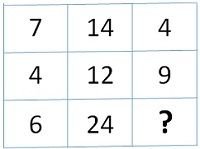
Select the missing number from the given responses:
74614122449?
💡Correct Answer: Option B (16)
Examine the relationship across each row (Row 1 to Row 3): - Row 1: Divide the middle number by the first, then square the result: (714)2=22=4 - Row 2: (412)2=32=9 - Row 3: (624)2=42=16 Thus, the missing number in the third column is 16.
A man starts from a point and walks 30 metres towards South. He turns to his right and walks 30 metres. He then turns to his left and walks 20 metres. Again he turns to his left and walks 30 metres. How far is he from his starting point?
💡Correct Answer: Option A (50 metres)
Let's trace the person's coordinates starting at (0,0): 1. 30 m South: (0,−30) 2. Turns right (facing West) and walks 30 m: (−30,−30) 3. Turns left (facing South) and walks 20 m: (−30,−50) 4. Turns left (facing East) and walks 30 m: (−30+30,−50)=(0,−50) The final position is directly 50 metres South of the starting point (0,0). Thus, he is 50 metres away.
Consider the given statements to be true, even if they seem to be at variance from commonly known facts, and decide which of the given conclusions logically follows from the statements:
Statements: 1. All teachers are actors. 2. Some actors are women.
Conclusions: I. All teachers are women. II. Some women are teachers. III. Some women are actors. IV. All actors are teachers.
💡Correct Answer: Option C (Only Conclusion III follows)
1. Statement 2 is a particular affirmative (I-type): 'Some actors are women'. The valid immediate conversion of an I-type proposition is another I-type: 'Some women are actors'. Thus, Conclusion III follows unconditionally. 2. There is no distributed middle term linking 'teachers' and 'women' (Actors is undistributed in both), so no valid relation can be deduced between teachers and women (Conclusions I and II do not follow). 3. 'All teachers are actors' converts to 'Some actors are teachers', not 'All' (Conclusion IV does not follow). Therefore, Only Conclusion III follows.
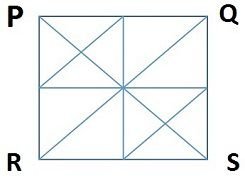
In the standard symmetrical square figure with central diagonals and cross-medians divided into quadrants: - Individual smallest unit triangles: 12 triangles. - Triangles composed of 2 smaller units: 8 triangles. - Triangles composed of 3/4 units forming larger quadrant triangles: 8 triangles. Total count = 12+8+8=28 triangles.
Which of the following Venn diagrams indicates the best relation between: Stationery items, Pencils, Potatoes?
💡Correct Answer: Option D (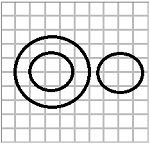)
1. All Pencils are Stationery items. Hence, the circle representing Pencils lies completely inside the circle representing Stationery items. 2. Potatoes are vegetables and have zero intersection with stationery or pencils. Hence, Potatoes is represented by an entirely separate, disjoint circle. This configuration (one circle inside another, with a third circle completely detached) is depicted in Option 4.
Which answer figure will complete the pattern in the question figure?
💡Correct Answer: Option B (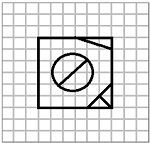)
To maintain 4-fold rotational symmetry and complete the geometric contours in the missing bottom-right quadrant, the lines and arcs must mirror the top-right quadrant across the horizontal axis. Option 2 provides the exact matching lines.
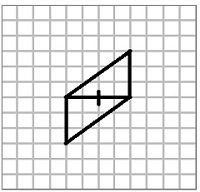
From the given answer figures, select the one in which the question figure is hidden/embedded:
💡Correct Answer: Option C (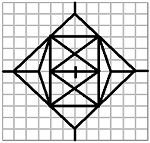)
Tracing the distinctive shape (a vertical stem connected to asymmetrical diagonal steps) within the options clearly reveals that it is embedded without change of orientation in Option 3.
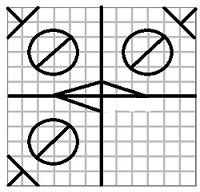
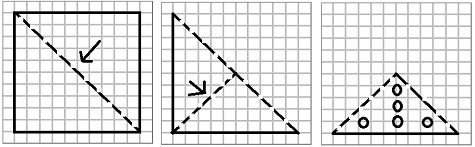
A piece of paper is folded and punched as shown below in the question figures. From the given answer figures, indicate how it will appear when opened:
💡Correct Answer: Option C (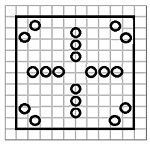)
When the circular punch made on the folded quarter section is unfolded horizontally and vertically, bilateral reflections reproduce the identical punch cuts across all four quadrants. This symmetrical layout corresponds directly to Option 3.
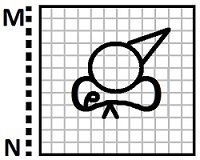
If a mirror is placed on the line MN, then which of the answer figures is the right image of the given figure?
💡Correct Answer: Option C ()
A vertical mirror reflects the left-right orientation while keeping the vertical top-bottom alignment unchanged. The elements on the right of the object move to the left in the reflection. This lateral inversion matches Option 3.
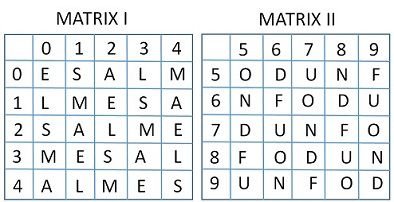
A word is represented by only one set of numbers as given in any one of the alternatives. The sets of numbers given in the alternatives are represented by two classes of alphabets as in two matrices given below. Identify the set for the word 'LEND':
💡Correct Answer: Option B (10, 31, 77, 99)
Let's check Option 2 (Row, Column) for each letter of 'LEND': - L: Row 1, Column 0 gives 'L' (10) ✓ - E: Row 3, Column 1 gives 'E' (31) ✓ - N: Row 7, Column 7 gives 'N' (77) ✓ - D: Row 9, Column 9 gives 'D' (99) ✓ All four coordinates perfectly spell 'LEND'. Thus, Option 2 (10, 31, 77, 99) is correct.
Q26
General Awareness & National Current Affairsgeneral-science-physics-chemistry-biology
Intensive cultivation refers to:
💡Correct Answer: Option C (Raising production by intensive use of existing land)
Intensive agriculture (or intensive farming) is an agricultural intensification system that aims to maximize agricultural output per unit area of existing cultivated land using high inputs of capital, fertilizers, pesticides, irrigation, and labor. Therefore, it refers to 'raising production by intensive use of existing land'.
Q27
General Awareness & National Current Affairsgeneral-science-physics-chemistry-biology
Serena Williams equalled the Open Era record of 22 Grand Slam singles titles previously held by:
💡Correct Answer: Option B (Steffi Graf)
At the 2016 Wimbledon Championships, Serena Williams won her 22nd Grand Slam singles title, equalling the Open Era record held by Germany's Steffi Graf (who won 22 major singles titles between 1987 and 1999).
Q28
General Awareness & National Current Affairsgeneral-science-physics-chemistry-biology
Which of the following blood groups is considered the universal donor?
💡Correct Answer: Option D (O)
Blood group O (specifically O negative) lacks both A and B surface antigens on red blood cells, which prevents an immunological reaction when transfused into recipients of any ABO blood type. Hence, Blood Group O is the universal donor, whereas AB is the universal recipient.
Q29
General Awareness & National Current Affairsgeneral-science-physics-chemistry-biology
Amir Khusro was a famous:
💡Correct Answer: Option A (Poet)
Ab'ul Hasan Yamin al-Din Khusrow, famously known as Amir Khusro (1253–1325), was an iconic Sufi musician, poet, and scholar during the Delhi Sultanate. Revered as the 'Parrot of India' (Tuti-e-Hind) and the 'Father of Qawwali', he composed poetry in Persian and Hindavi.
Q30
General Awareness & National Current Affairsgeneral-science-physics-chemistry-biology
The members of the All India Services serve:
💡Correct Answer: Option D (Both the Union and State Governments)
Under Article 312 of the Constitution of India, the All India Services (IAS, IPS, and IFoS) are recruited and trained by the Union Government but allocated to state cadres. Officers serve both the Union and State Governments during their careers.
Q31
General Awareness & National Current Affairsgeneral-science-physics-chemistry-biology
The term of office of the Vice-President of India is:
💡Correct Answer: Option B (5 years)
According to Article 67 of the Constitution of India, the Vice-President holds office for a term of five years from the date on which he enters upon his office.
Q32
General Awareness & National Current Affairsgeneral-science-physics-chemistry-biology
Who was instrumental in the integration of the princely states into the Indian Union?
💡Correct Answer: Option C (Sardar Vallabhbhai Patel)
Sardar Vallabhbhai Patel (the first Deputy Prime Minister and Minister of Home Affairs), assisted by V. P. Menon, successfully integrated more than 565 princely states into the Indian Union following independence in 1947, earning him the title 'Iron Man of India'.
Q33
General Awareness & National Current Affairsgeneral-science-physics-chemistry-biology
The west coast of India receives more rainfall than the east coast because:
💡Correct Answer: Option B (The Western Ghats obstruct the winds causing rainfall)
The Western Ghats form an unbroken continuous mountain barrier perpendicular to the incoming moisture-laden South-West monsoon winds from the Arabian Sea. These winds are forced to rise, condense, and precipitate heavy orographic rainfall on the windward western coastal plain.
Q34
General Awareness & National Current Affairsgeneral-science-physics-chemistry-biology
The plateau that has both West and East flowing drainage systems is:
💡Correct Answer: Option A (Malwa)
The Malwa Plateau acts as a water divide between the Arabian Sea and Bay of Bengal drainages. Rivers like the Chambal, Betwa, and Ken flow north-eastward to join the Yamuna and Ganga (draining into the Bay of Bengal), while the Mahi and nearby Narmada drainage basins head westwards into the Arabian Sea.
Q35
General Awareness & National Current Affairsgeneral-science-physics-chemistry-biology
In which of the following plants are nitrogen-fixing symbiotic bacteria found?
💡Correct Answer: Option A (Peas)
Leguminous plants such as peas (Pisum sativum), beans, and lentils form symbiotic relationships with nitrogen-fixing bacteria (Rhizobium) within specialized root nodules, converting atmospheric nitrogen into bioavailable ammonium compounds.
Q36
General Awareness & National Current Affairsgeneral-science-physics-chemistry-biology
Lack of sunshine in children causes:
💡Correct Answer: Option A (Rickets)
Sunlight stimulates the synthesis of Vitamin D (cholecalciferol) in the skin. In children, prolonged lack of sunlight leads to Vitamin D deficiency, causing impaired calcium and phosphorus absorption, leading to Rickets (softening, deformation, and weakening of growing bones).
Q37
General Awareness & National Current Affairsgeneral-science-physics-chemistry-biology
Chloramines are used in municipal water treatment for:
💡Correct Answer: Option C (Disinfection)
Chloramines (formed by reacting chlorine with ammonia) are widely used as secondary disinfectants in drinking water distribution systems because they produce lower levels of harmful disinfection byproducts (trihalomethanes) and provide longer-lasting residual protection against microbial contamination.
Q38
General Awareness & National Current Affairsgeneral-science-physics-chemistry-biology
Supercooling is cooling of a liquid:
💡Correct Answer: Option B (Below freezing point)
Supercooling (undercooling) is the process of lowering the temperature of a liquid below its freezing point without it becoming a solid, which occurs in the absence of a crystal nucleus or seed around which crystallization can initiate.
Q39
General Awareness & National Current Affairsgeneral-science-physics-chemistry-biology
Alcohol is more volatile than water because its ______ is lower:
💡Correct Answer: Option A (Boiling point)
Ethanol has weaker intermolecular hydrogen bonding than water, giving it a much lower boiling point (78.37∘C compared to water's 100∘C) and a higher vapor pressure at ambient temperatures, making it significantly more volatile.
Q40
General Awareness & National Current Affairsgeneral-science-physics-chemistry-biology
Protection of objects and access control in a computer operating system is commonly achieved through:
💡Correct Answer: Option C (Passwords)
In operating systems and computer security, passwords represent the primary, universal mechanism of user authentication and access control to protect files, accounts, and system objects from unauthorized modification or viewing.
Q41
General Awareness & National Current Affairsgeneral-science-physics-chemistry-biology
Which of the following is NOT a Non-Banking Financial Institution (NBFI)?
💡Correct Answer: Option D (BOI)
Bank of India (BOI) is a Scheduled Public Sector Commercial Bank accepting demand deposits from the general public. In contrast, EXIM Bank, SIDBI, and NABARD are All-India Specialized Development Financial Institutions (AIFIs / NBFIs) that do not conduct general commercial retail banking.
Q42
General Awareness & National Current Affairsgeneral-science-physics-chemistry-biology
Hardness of water is tested by:
💡Correct Answer: Option C (Formation of lather with soap)
Hard water contains dissolved calcium and magnesium ions (Ca2+,Mg2+) that react with soap molecules to precipitate an insoluble curdy scum (calcium stearate) rather than forming a rich lather. Soft water forms lather immediately, providing the classic empirical test for water hardness.
Q43
General Awareness & National Current Affairsgeneral-science-physics-chemistry-biology
Who is the first Indian Gold Medal Winner in individual category in Olympic games?
💡Correct Answer: Option A (Abhinav Bindra)
Abhinav Bindra created history by winning India's first-ever individual Olympic Gold medal in the Men's 10m Air Rifle shooting event at the 2008 Beijing Olympic Games.
(Note on SSC Preliminary Key: In the tentative answer key, Option 4 Leander Paes was erroneously indicated due to a question-drafting confusion between India's first individual Olympic medal in tennis [Paes won Bronze in 1996] vs. Olympic Gold medal. Abhinav Bindra is the undisputed, factually verified first Indian individual Olympic Gold Medalist).
Q44
General Awareness & National Current Affairsgeneral-science-physics-chemistry-biology
Which is the warmest layer of the atmosphere?
💡Correct Answer: Option A (Thermosphere)
The Thermosphere (extending from roughly 85 km to 600 km above Earth) is the warmest atmospheric layer. In this layer, highly energetic solar X-rays and short-wave ultraviolet radiation are directly absorbed by residual nitrogen and oxygen atoms, causing temperatures to reach up to 1,500∘C to 2,000∘C or higher.
Q45
General Awareness & National Current Affairsgeneral-science-physics-chemistry-biology
Which of the following blood groups is known as the universal donor?
💡Correct Answer: Option D (O)
Blood group O red blood cells contain neither A nor B antigens on their surface, so they can be safely given to individuals of any ABO blood type without triggering an adverse hemolytic immune response. Thus, Group O is the universal donor.
Q46
General Awareness & National Current Affairsgeneral-science-physics-chemistry-biology
The melting waters of the Siachen Glacier are the main source of which river?
💡Correct Answer: Option D (Nubra)
The snout of the Siachen Glacier in Ladakh gives rise to the Nubra River, which flows through the Nubra Valley before converging with the Shyok River (which subsequently drains into the Indus River).
Q47
General Awareness & National Current Affairsgeneral-science-physics-chemistry-biology
The Thomas Cup is associated with which sport?
💡Correct Answer: Option D (Badminton)
The Thomas Cup (officially known as the World Men's Team Championships) is the premier international badminton competition contested by national men's teams of the Badminton World Federation (BWF).
Q48
General Awareness & National Current Affairsgeneral-science-physics-chemistry-biology
The famous historical novel 'Anandmath' was written by:
💡Correct Answer: Option B (Bankim Chandra Chatterjee)
'Anandmath' was written in 1882 by Bankim Chandra Chatterjee. Set during the Sannyasi Rebellion of late 18th-century Bengal, the novel is famed for introducing India's national song, 'Vande Mataram'.
Q49
General Awareness & National Current Affairsgeneral-science-physics-chemistry-biology
The term 'Hindu rate of growth' was coined by which economist?
💡Correct Answer: Option B (Raj Krishna)
The term 'Hindu rate of growth' was coined in 1978 by Indian economist Prof. Raj Krishna to describe the sluggish annual GDP growth rate of around 3.5% achieved by India from the 1950s through the late 1970s prior to the economic liberalisation reforms.
Q50
General Awareness & National Current Affairsgeneral-science-physics-chemistry-biology
The BRICS New Development Bank (NDB) was established primarily for:
💡Correct Answer: Option A (Funding infrastructure projects in emerging economies for sustainable development)
The New Development Bank (NDB), established by the BRICS nations (Brazil, Russia, India, China, and South Africa) in 2014 at the Fortaleza Summit, was founded to mobilize resources for infrastructure and sustainable development projects in BRICS and other emerging market economies and developing countries.
A can do a piece of work in 9 days while B can do it in 12 days. A and B together can do the work in:
💡Correct Answer: Option A ($$5\frac{1}{7}\text{ days}$$)
Let the total work be the LCM of 9 and 12, which is 36 units. - A's 1-day work = 936=4 units/day - B's 1-day work = 1236=3 units/day Combined work per day = 4+3=7 units/day Total days required together: Time=736=571 days
A retailer gets a discount of 40% on the printed price of an article. The retailer sells it at the printed price. His gain percent is:
💡Correct Answer: Option C ($$66\frac{2}{3}\%$$)
Let the printed price (Marked Price) be ₹100. - Cost Price for the retailer (CP) = ₹(100 - 40) = ₹60 - Selling Price for the retailer (SP) = Printed Price = ₹100 Profit = SP−CP=100−60=₹40 Profit percentage: Gain %=(CPProfit)×100=(6040)×100=3200%=6632%
In a mixture of 28 litres, the ratio of spirit and water is 3 : 2. If the spirit is 3 litres more than the water in the mixture, then what is the quantity of spirit?
💡Correct Answer: Option C (9 litres)
Let the quantity of spirit be 3x litres and water be 2x litres. According to the problem: Spirit−Water=3x−2x=x=3 litres Therefore: Quantity of Spirit=3x=3×3=9 litres
The cost price of 25 pens is equal to the selling price of 20 pens. Find the gain percent:
💡Correct Answer: Option B (25%)
Given: 25×CP=20×SP CPSP=2025=45 For every ₹4 of cost price, the selling price is ₹5, giving a profit of ₹1. Gain %=(CPSP−CP)×100=(45−4)×100=41×100=25%
Two persons start from the same point at the same time and travel in the same direction with speeds of 25 km/h and 35 km/h. If one person is initially 60 km behind, in how many hours will the faster person catch up?
💡Correct Answer: Option C (6 hours)
Since both travel in the same direction, the relative speed is the difference between their speeds: Relative Speed=35−25=10 km/h Time required to cover the 60 km gap: Time=Relative SpeedDistance=1060=6 hours
If the simple interest on a certain sum of money for 5 years at 6% per annum is ₹60, then the sum (Principal) is:
💡Correct Answer: Option A (₹200)
Using the Simple Interest formula: SI=100P×R×T Substitute the given values (SI=60,R=6,T=5): 60=100P×6×5=10030P P=3060×100=200 Hence, the Principal is ₹200.
If (x−3)2+(y−4)2+(z−5)2=0, then (x+y+z) is equal to:
💡Correct Answer: Option D (12)
Since the square of any real number is non-negative (A2≥0), the sum of three real squares can equal zero if and only if each individual term is identically zero: 1. (x−3)2=0⟹x=3 2. (y−4)2=0⟹y=4 3. (z−5)2=0⟹z=5 Summing them: x+y+z=3+4+5=12
From the given equation: 2x+3x1=5 Multiply through by 3x: 6x2+1=15x Now rewrite the denominator of the target expression: 6x2+20x+1=(6x2+1)+20x=15x+20x=35x Substitute this into the fraction: 6x2+20x+15x=35x5x=355=71
By definition: - Orthocentre: The intersection point of the three altitudes (perpendiculars from vertices to opposite sides). - Centroid: The intersection point of the medians. - Circumcentre: The intersection of the perpendicular bisectors of the sides. - Incentre: The intersection of the angle bisectors.
ABCD is a cyclic trapezium with AD∥BC. If ∠ABC=70∘, then ∠BCD is:
💡Correct Answer: Option C (70°)
A cyclic trapezium is always an isosceles trapezium (its non-parallel sides are equal, AB=CD). 1. Since AD∥BC, consecutive interior angles are supplementary: ∠BAD+∠ABC=180∘⟹∠BAD=180∘−70∘=110∘ 2. In a cyclic quadrilateral, opposite angles sum to 180∘: ∠BAD+∠BCD=180∘⟹∠BCD=180∘−110∘=70∘ Therefore, base angles are equal: ∠BCD=70∘.
💡Correct Answer: Option A ($$\frac{x}{\sqrt{1 - x^2}}$$)
Using complementary angle identities: tan63∘=tan(90∘−27∘)=cot27∘=sin27∘cos27∘ Since cos27∘=x, we have: sin27∘=1−cos227∘=1−x2 Therefore: tan63∘=1−x2x
In an Arithmetic Progression (A.P.), the sum of the first 10 terms is 390 and the third term is 19. Find the first term (a):
💡Correct Answer: Option A (3)
Let a be the first term and d be the common difference. 1. Third term: T3=a+2d=19⟹2a+4d=38 2. Sum of 10 terms: S10=210[2a+9d]=5(2a+9d)=390⟹2a+9d=78 3. Subtracting equation (1) from (2): (2a+9d)−(2a+4d)=78−38⟹5d=40⟹d=8 4. Finding a: a=19−2(8)=19−16=3 Hence, the first term is 3.
The average marks obtained by 100 candidates in an examination is 30. If the average marks of the passed candidates is 35 and that of the failed candidates is 10, what is the number of candidates who passed the examination?
💡Correct Answer: Option C (80)
Using the Rule of Alligation: - Passed candidates' average = 35 - Failed candidates' average = 10 - Overall mean average = 30 Ratio of Passed to Failed: Ratio=(30−10):(35−30)=20:5=4:1 Total parts = 4+1=5 Number of passed candidates: P=(54)×100=80
Using the algebraic identity relating sums and differences: (a−b)2=(a+b)2−4ab Substitute the given values: (a−b)2=102−4(21)=100−84=16 Hence, (a−b)2=16.
Recall the standard cubic expansion formula: (a−b)(a2+ab+b2)=a3−b3 Here, setting a=x and b=4: (x−4)(x2+4x+16)=x3−43=x3−64 Comparing with x3−P, we immediately find P=64.
G is the centroid of △ABC. If AG=BC, then ∠BGC is equal to:
💡Correct Answer: Option C (90°)
Let D be the midpoint of side BC, making AD the median through A. 1. The centroid G divides median AD in the ratio 2:1, so: AG=2GD⟹GD=21AG 2. Since given AG=BC, we have: GD=21BC 3. Since D is the midpoint of BC, BD=CD=21BC. 4. Thus, in △BGC, median GD=BD=CD. When the median to a side in a triangle equals half that side, the triangle is a right-angled triangle with the right angle opposite to that side. Therefore, ∠BGC=90∘.
A chord of length 52 cm subtends a right angle at the centre of a circle. The radius of the circle is:
💡Correct Answer: Option B (5 cm)
Let r be the radius of the circle. The chord forms a right-angled isosceles triangle with the two radii at the centre of the circle: r2+r2=(Chord)2 2r2=(52)2=25×2=50 r2=250=25⟹r=5 cm Thus, the radius is 5 cm.
An aeroplane is flying horizontally at a constant height of 2500 m above the ground. From a point on the ground, the angle of elevation of the aeroplane changes from 45∘ to 30∘ in 15 seconds. Find the speed of the aeroplane in km/h:
💡Correct Answer: Option D ($$600(\sqrt{3} - 1)$$)
Let the height be h=2500 m. - Initial horizontal distance: x1=tan45∘2500=2500 m - Second horizontal distance: x2=tan30∘2500=25003 m Distance travelled in 15 seconds: d=x2−x1=2500(3−1) m Speed in km/h: Speed=152500(3−1)×518=5500×6(3−1)=600(3−1) km/h
1000 solid metallic small spheres of diameter 6 cm each are melted to form a single large solid sphere. The diameter of the new sphere is:
💡Correct Answer: Option D (60 cm)
Radius of each small sphere = r=26=3 cm. Total volume of 1000 small spheres equals the volume of the large sphere (R): 1000×34πr3=34πR3 R3=1000×33=1000×27=27000 R=327000=30 cm Therefore, the diameter of the new sphere is: D=2R=2×30=60 cm
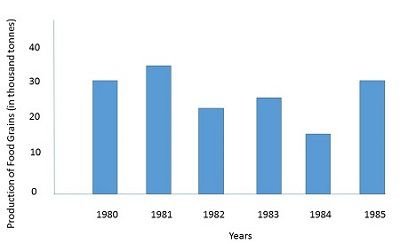
The bar chart shows the production of food grains (in thousand tonnes) over the years 1980 to 1985:
The sum of food grains production in the year 1982 and 1984 is equal to that of the year:
💡Correct Answer: Option B (1981)
From the bar chart: - Production in 1982 = 20 thousand tonnes - Production in 1984 = 15 thousand tonnes Sum = 20+15=35 thousand tonnes Looking at the chart, the year 1981 has a production of exactly 35 thousand tonnes.
Based on the bar chart, the difference between the food grains production of the year 1981 and 1985 is:
💡Correct Answer: Option C (5000 tonnes)
From the bar chart: - Production in 1981 = 35 thousand tonnes - Production in 1985 = 30 thousand tonnes Difference = 35−30=5 thousand tonnes=5,000 tonnes.
The percentage increase in production from 1984 to 1985 is:
💡Correct Answer: Option D (100%)
From the bar chart: - Production in 1984 = 15 thousand tonnes - Production in 1985 = 30 thousand tonnes Increase = 30−15=15 thousand tonnes Percentage increase: Percentage Increase=(1515)×100=100%
The rate of change in food grains production was minimum between which two consecutive years?
💡Correct Answer: Option A (1980 and 1981)
Calculating the percentage rate of change between consecutive pairs of years: - 1980 to 1981: 3035−30×100=305×100=16.67% - 1981 to 1982: 35∣20−35∣×100=3515×100=42.86% - 1982 to 1983: 2025−20×100=205×100=25.00% - 1983 to 1984: 25∣15−25∣×100=2510×100=40.00% - 1984 to 1985: 1530−15×100=100.00% The minimum rate of change occurred between 1980 and 1981 (16.67%).
Q76
General English & Comprehensiongeneral-english-vocabulary-idioms
In the following question, out of the four alternatives, choose the one which best expresses the meaning of the given word: NONPLUSSED
💡Correct Answer: Option C (PUZZLED)
Nonplussed means so surprised, bewildered, or confused that one is unsure how to react or what to say. Synonyms include bewildered, perplexed, baffled, and puzzled.
Q77
General English & Comprehensiongeneral-english-vocabulary-idioms
In the following question, choose the word opposite in meaning to the given word: VISIONARY
💡Correct Answer: Option A (REALIST)
A visionary is someone characterized by fanciful, idealistic dreams or foresight that may not be grounded in current practical reality. The opposite is a realist—a person who accepts things as they actually exist in practice rather than how they are imagined.
Q78
General English & Comprehensiongeneral-english-vocabulary-idioms
Select the correctly spelt word from the given options:
💡Correct Answer: Option D (Disorientation)
The correct standard English spelling is Disorientation (prefix 'dis-' + 'orientation', meaning the condition of having lost one's sense of direction or awareness).
Q79
General English & Comprehensiongeneral-english-vocabulary-idioms
In the following question, some parts of the sentence have errors and some are correct. Find out which part of the sentence has an error: "I will not (A) / stay here another minute (B) / if I can help it! (C) / No Error (D)"
💡Correct Answer: Option D (D (No Error))
The sentence is grammatically flawless. The idiom "if I can help it" is standard English meaning "if I have any control over the situation" or "if I can prevent it". Thus, there is No Error (D).
Q80
General English & Comprehensiongeneral-english-vocabulary-idioms
In the following question, find out which part of the sentence has an error: "Roger dressed (A) / in is best shirt, (B) / silver tie and black look. (C) / No Error (D)"
💡Correct Answer: Option B (B)
Part (B) contains a grammatical error: the third-person singular possessive pronoun 'his' is mistakenly replaced with the verb 'is' ("in is best shirt"). It should correctly read: "in his best shirt".
Q81
General English & Comprehensiongeneral-english-vocabulary-idioms
In the following question, find out which part of the sentence has an error: "They are looking forward (A) / to meet (B) / their parents (C) / No Error (D)"
💡Correct Answer: Option B (B)
In the phrasal verb 'look forward to', the word 'to' acts as a preposition, which must always be followed by a noun or gerund (V-ing form), never a bare infinitive. Therefore, 'to meet' should be corrected to 'to meeting' in part (B).
Q82
General English & Comprehensiongeneral-english-vocabulary-idioms
Fill in the blank with the appropriate option: "You are _______ common sense."
💡Correct Answer: Option C (devoid of)
The adjective 'devoid' takes the fixed preposition 'of' (devoid of), meaning entirely lacking, empty, or free from something. ('Lacking' when used with 'of' is incorrect; one simply says 'lacking common sense'). Thus, 'devoid of' is correct.
Q83
General English & Comprehensiongeneral-english-vocabulary-idioms
Fill in the blank with the appropriate option: "He ran so fast _______"
💡Correct Answer: Option A (that he fell)
The correlative conjunction structure 'so + adjective/adverb + that + clause' expresses cause and result. Furthermore, since the main verb 'ran' is in the past tense, the result clause must also be in the past tense: "that he fell".
Q84
General English & Comprehensiongeneral-english-vocabulary-idioms
Fill in the blank with the appropriate option: "The doctor has been _______ to attend to an urgent case."
💡Correct Answer: Option A (called)
In the official paper, the passive construction is completed with the past participle 'called' ("The doctor has been called to attend..."), meaning summoned.
Q85
General English & Comprehensiongeneral-english-vocabulary-idioms
In the following question, out of the four alternatives, choose the one which best expresses the meaning of the given idiom/phrase: "To nip in the bud"
💡Correct Answer: Option A (To stop something at the start)
The idiom "to nip in the bud" originates from horticulture (pinching off flower buds to prevent them from growing) and metaphorically means to suppress, halt, or destroy a problem in its earliest beginning stage before it can develop further.
Q86
General English & Comprehensiongeneral-english-vocabulary-idioms
In the following question, out of the four alternatives, choose the one which best expresses the meaning of the given idiom/phrase: "To put a spoke in one's wheel"
💡Correct Answer: Option B (To hinder)
"To put a spoke in someone's wheel" means to obstruct, disrupt, or thwart someone's plans, preventing them from progressing smoothly. Hence, it means to hinder.
Q87
General English & Comprehensiongeneral-english-vocabulary-idioms
In the following question, out of the four alternatives, choose the one which best expresses the meaning of the given idiom/phrase: "To clip one's wings"
💡Correct Answer: Option C (To deprive one of power)
"To clip one's wings" refers to restricting someone's authority, freedom, or independence, thereby depriving them of power or influence.
Q88
General English & Comprehensiongeneral-english-vocabulary-idioms
Out of the four alternatives, choose the one which can be substituted for the given words/sentence: "An act of travelling from one place to another"
💡Correct Answer: Option B (Journey)
The act of travelling from a starting location to a destination, especially over a considerable distance, is defined as a Journey.
Q89
General English & Comprehensiongeneral-english-vocabulary-idioms
Out of the four alternatives, choose the one which can be substituted for the given words/sentence: "A thing no longer in use"
💡Correct Answer: Option B (Obsolete)
Something that is out of date, replaced by newer technology or designs, and no longer used or produced is termed Obsolete.
Q90
General English & Comprehensiongeneral-english-vocabulary-idioms
Out of the four alternatives, choose the one which can be substituted for the given words/sentence: "Misappropriation of money"
💡Correct Answer: Option A (Embezzlement)
Embezzlement specifically denotes the unlawful theft or fraudulent misappropriation of funds or property entrusted to one's care or custody (such as by an employee or trustee).
Q91
General English & Comprehensiongeneral-english-vocabulary-idioms
Improve the bracketed part of the sentence: "The teacher congratulated the blind student [for his] success in the exam."
💡Correct Answer: Option B (on his)
The standard preposition that follows the verb congratulate is 'on' (e.g., 'to congratulate someone on an achievement/success'). Hence, 'for his' must be replaced by 'on his'.
Q92
General English & Comprehensiongeneral-english-vocabulary-idioms
Improve the bracketed part of the sentence: "I am sorry but I [will not believe] the story when you say two plus two equals five."
💡Correct Answer: Option A (do not believe)
'Believe' is a stative verb representing an ongoing cognitive state in the present. In the context of a general present truth ('when you say two plus two equals five'), the simple present negative 'do not believe' is the appropriate grammatical form.
Q93
General English & Comprehensiongeneral-english-vocabulary-idioms
Improve the bracketed part of the sentence: "Due to rain, the builders have [stopped from constructing] the bridge."
💡Correct Answer: Option C (stopped constructing)
When the verb stop means to cease an ongoing activity, it takes a direct gerund as its object ('stop doing something'), without the preposition 'from'. Thus, it should be 'stopped constructing'.
Q94
General English & Comprehensiongeneral-english-vocabulary-idioms
Improve the bracketed part of the sentence: "Due to his poor performance in the interview, he [cut an angry figure] on the stage."
💡Correct Answer: Option C (cut a sorry figure)
The standard English idiomatic expression is "to cut a sorry figure", which means to create a poor, embarrassing, or pathetic impression.
Q95
General English & Comprehensiongeneral-english-vocabulary-idioms
Improve the bracketed part of the sentence: "My brother [would gladly given] you his car if you had asked him."
💡Correct Answer: Option B (would have gladly given)
This is a Type-3 conditional sentence (unfulfilled past condition). The formula is: `If + had + V3 ..., Subject + would have + V3`. Therefore, the main clause requires "would have gladly given".
Q96
General English & Comprehensiongeneral-english-vocabulary-idioms
Read the following passage carefully and answer the questions that follow:
Ants have been living on the earth for more than 100 million years and can be found almost anywhere on the planet. It is estimated that there are about 20000 different species of ants. For this reason ants have been called Earth's most successful species. If you watch ants for any length of time you will see that they really do communicate with each other and very effectively too. Ants communicate by touching each other with their antennae. Ants also use chemicals called pheromones to leave scent trails for other ants to follow. Ants build many different types of homes. Many ants build simple little mounds out of dirt or sand. Other ants use small sticks mixed with dirt and sand to make a stronger mound that offers protection from rain. Western Harvester ants make a small mound on top, but then tunnels up to 15 feet straight down to hibernate during winter. Ant mounds consist of many chambers connected by tunnels. Different chambers are used for nurseries, food storage, and resting places for the worker ants. Some ants live in wood like termites. Army ants don't make a home at all but travel in large groups searching for food. Ants are social insects which means they live in large colonies or groups. Some colonies consist of millions of ants. There are three types of ants in each species: the queen, the sterile female workers, and males. The male ants only serve one purpose, to mate with future queen ants and do not live very long. The queen grows to adulthood, mates, and then spends rest of her life laying eggs. A colony may have only one queen, or there may be many queens depending on the species. Ants go through four stages of development: egg, larva, pupa, and adult.
Why are ants called Earth's most successful species?
💡Correct Answer: Option C (Because they have been on earth for more than a 100 million years and because they can be found anywhere on earth)
The opening lines of the passage state: "Ants have been living on the earth for more than 100 million years and can be found almost anywhere on the planet... For this reason ants have been called Earth's most successful species." Option 3 correctly combines both stated reasons.
Q97
General English & Comprehensiongeneral-english-vocabulary-idioms
Read the following passage carefully and answer the questions that follow:
Ants have been living on the earth for more than 100 million years and can be found almost anywhere on the planet. It is estimated that there are about 20000 different species of ants. For this reason ants have been called Earth's most successful species. If you watch ants for any length of time you will see that they really do communicate with each other and very effectively too. Ants communicate by touching each other with their antennae. Ants also use chemicals called pheromones to leave scent trails for other ants to follow. Ants build many different types of homes. Many ants build simple little mounds out of dirt or sand. Other ants use small sticks mixed with dirt and sand to make a stronger mound that offers protection from rain. Western Harvester ants make a small mound on top, but then tunnels up to 15 feet straight down to hibernate during winter. Ant mounds consist of many chambers connected by tunnels. Different chambers are used for nurseries, food storage, and resting places for the worker ants. Some ants live in wood like termites. Army ants don't make a home at all but travel in large groups searching for food. Ants are social insects which means they live in large colonies or groups. Some colonies consist of millions of ants. There are three types of ants in each species: the queen, the sterile female workers, and males. The male ants only serve one purpose, to mate with future queen ants and do not live very long. The queen grows to adulthood, mates, and then spends rest of her life laying eggs. A colony may have only one queen, or there may be many queens depending on the species. Ants go through four stages of development: egg, larva, pupa, and adult.
Ants use antennae to:
💡Correct Answer: Option B (Communicate)
The passage explicitly states: "Ants communicate by touching each other with their antennae." Hence, antennae are used to communicate.
Q98
General English & Comprehensiongeneral-english-vocabulary-idioms
Read the following passage carefully and answer the questions that follow:
Ants have been living on the earth for more than 100 million years and can be found almost anywhere on the planet. It is estimated that there are about 20000 different species of ants. For this reason ants have been called Earth's most successful species. If you watch ants for any length of time you will see that they really do communicate with each other and very effectively too. Ants communicate by touching each other with their antennae. Ants also use chemicals called pheromones to leave scent trails for other ants to follow. Ants build many different types of homes. Many ants build simple little mounds out of dirt or sand. Other ants use small sticks mixed with dirt and sand to make a stronger mound that offers protection from rain. Western Harvester ants make a small mound on top, but then tunnels up to 15 feet straight down to hibernate during winter. Ant mounds consist of many chambers connected by tunnels. Different chambers are used for nurseries, food storage, and resting places for the worker ants. Some ants live in wood like termites. Army ants don't make a home at all but travel in large groups searching for food. Ants are social insects which means they live in large colonies or groups. Some colonies consist of millions of ants. There are three types of ants in each species: the queen, the sterile female workers, and males. The male ants only serve one purpose, to mate with future queen ants and do not live very long. The queen grows to adulthood, mates, and then spends rest of her life laying eggs. A colony may have only one queen, or there may be many queens depending on the species. Ants go through four stages of development: egg, larva, pupa, and adult.
What does the Western Harvester ant do during winter?
💡Correct Answer: Option C (It hibernates)
The passage states: "Western Harvester ants make a small mound on top, but then tunnels up to 15 feet straight down to hibernate during winter."
Q99
General English & Comprehensiongeneral-english-vocabulary-idioms
Read the following passage carefully and answer the questions that follow:
Ants have been living on the earth for more than 100 million years and can be found almost anywhere on the planet. It is estimated that there are about 20000 different species of ants. For this reason ants have been called Earth's most successful species. If you watch ants for any length of time you will see that they really do communicate with each other and very effectively too. Ants communicate by touching each other with their antennae. Ants also use chemicals called pheromones to leave scent trails for other ants to follow. Ants build many different types of homes. Many ants build simple little mounds out of dirt or sand. Other ants use small sticks mixed with dirt and sand to make a stronger mound that offers protection from rain. Western Harvester ants make a small mound on top, but then tunnels up to 15 feet straight down to hibernate during winter. Ant mounds consist of many chambers connected by tunnels. Different chambers are used for nurseries, food storage, and resting places for the worker ants. Some ants live in wood like termites. Army ants don't make a home at all but travel in large groups searching for food. Ants are social insects which means they live in large colonies or groups. Some colonies consist of millions of ants. There are three types of ants in each species: the queen, the sterile female workers, and males. The male ants only serve one purpose, to mate with future queen ants and do not live very long. The queen grows to adulthood, mates, and then spends rest of her life laying eggs. A colony may have only one queen, or there may be many queens depending on the species. Ants go through four stages of development: egg, larva, pupa, and adult.
What kind of homes do army ants build?
💡Correct Answer: Option D (They do not make homes but travel in search of food)
The passage states: "Army ants don't make a home at all but travel in large groups searching for food."
Q100
General English & Comprehensiongeneral-english-vocabulary-idioms
Read the following passage carefully and answer the questions that follow:
Ants have been living on the earth for more than 100 million years and can be found almost anywhere on the planet. It is estimated that there are about 20000 different species of ants. For this reason ants have been called Earth's most successful species. If you watch ants for any length of time you will see that they really do communicate with each other and very effectively too. Ants communicate by touching each other with their antennae. Ants also use chemicals called pheromones to leave scent trails for other ants to follow. Ants build many different types of homes. Many ants build simple little mounds out of dirt or sand. Other ants use small sticks mixed with dirt and sand to make a stronger mound that offers protection from rain. Western Harvester ants make a small mound on top, but then tunnels up to 15 feet straight down to hibernate during winter. Ant mounds consist of many chambers connected by tunnels. Different chambers are used for nurseries, food storage, and resting places for the worker ants. Some ants live in wood like termites. Army ants don't make a home at all but travel in large groups searching for food. Ants are social insects which means they live in large colonies or groups. Some colonies consist of millions of ants. There are three types of ants in each species: the queen, the sterile female workers, and males. The male ants only serve one purpose, to mate with future queen ants and do not live very long. The queen grows to adulthood, mates, and then spends rest of her life laying eggs. A colony may have only one queen, or there may be many queens depending on the species. Ants go through four stages of development: egg, larva, pupa, and adult.
What is the primary purpose of male ants?
💡Correct Answer: Option C (To mate with future queen ants)
The passage explicitly notes: "The male ants only serve one purpose, to mate with future queen ants and do not live very long."
🎯 Ready for a Timed Mock Test?
Simulate the real exam experience with a countdown timer, negative marking, and instant detailed scorecards.
About SSC CGL Tier-1 (11 Sep Shift 1) 2016 Previous Year Paper
This page provides the full solved question paper for the SSC CGL Tier-1 (11 Sep Shift 1) examination conducted in 2016 by the Staff Selection Commission. Every MCQ is presented with verified answer keys and detailed bilingual explanations to support concept building.
Key subjects covered in this paper include Mental Ability & Logical Reasoning, General Awareness & National Current Affairs, Quantitative Aptitude & Basic Mathematics, General English & Comprehension. Practicing authentic previous year questions is the proven way to master question patterns and improve accuracy for upcoming exams across Jammu & Kashmir.